URL Guard - AI-Assisted Malicious URL Detection
⚠ In development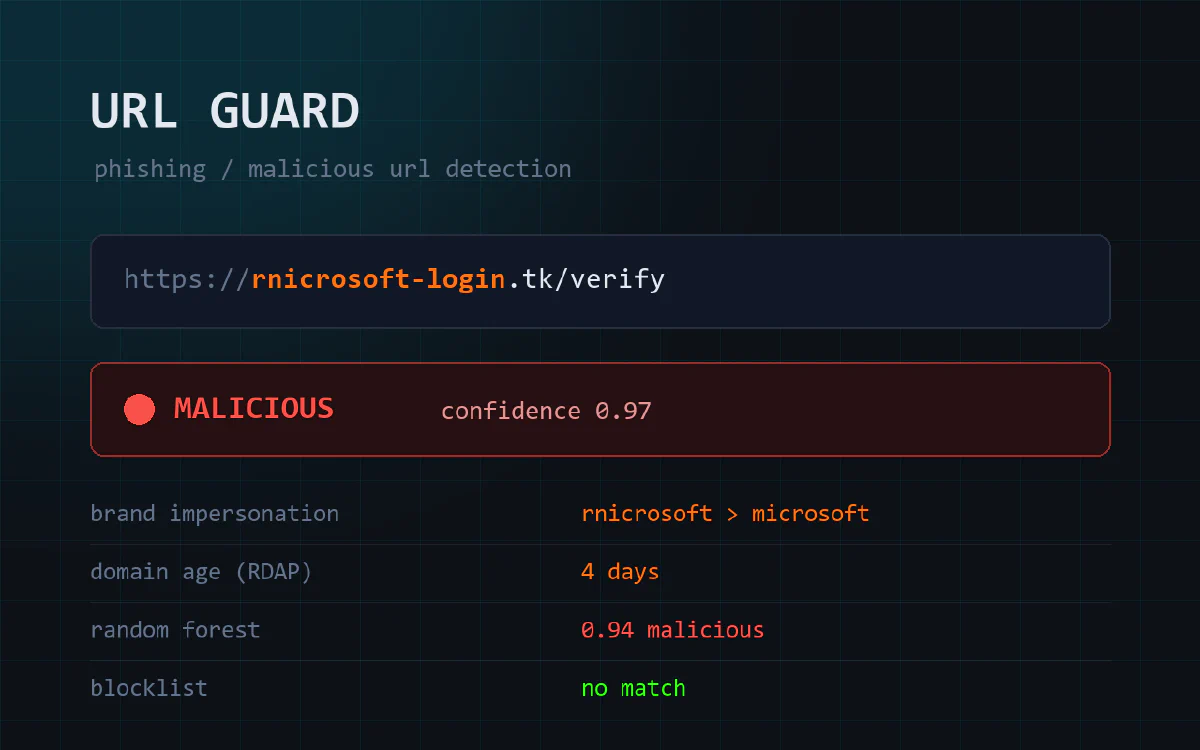
A self-training, locally hosted phishing and malicious URL detector that combines machine learning, rule-based analysis, threat intelligence and AI into a single decision engine.
The problem it solves
Most URL checkers either look only at a blocklist — blind to fresh attacks — or return a single black-box score with no stated reasoning. URL Guard does both, and adds the judgement of a SOC analyst on top: it reads every piece of evidence, resolves the contradictions between them, and produces a reasoned verdict with a confidence score.
The decision engine
Evidence is gathered from several independent sources:
- Machine learning — A Random Forest trained on 24 lexical and structural features, designed to generalise rather than memorise URL strings.
- Blocklists — OpenPhish and URLhaus feeds refreshed automatically every 12 hours. A blocklist hit counts as hard evidence and cannot be overridden by any other source.
- Brand impersonation — Levenshtein distance and IDN homograph analysis catch visual look-alikes such as
rnicrosoft→microsoft, or Cyrillicаpassing as Latina. - Domain and certificate trust — Domain age and registrar via RDAP, certificate validity, TLS version, redirect chain, and cross-domain/downgrade detection.
- External verification — A live screenshot and independent engine verdict from URLScan.io, plus IP reputation from AbuseIPDB.
What sets it apart
- A model that trains itself — High-confidence AI verdicts feed back into the Random Forest, retraining it in the background. The large model continuously improves the small one (knowledge distillation).
- Built against false positives — Legitimate sites are recognised by learning from the 50,000 most-visited real domains rather than a hardcoded allowlist.
- IP awareness — Given a bare IP address, reverse DNS with forward confirmation checks who actually owns it, and the model’s overconfidence on unknown IPs is deliberately capped.
- Hardened from day one — Rate limiting, SSRF protection, input validation and admin brute-force protection were in place before it ever went live.
Technical build
Python 3.10+, Flask and scikit-learn, with the AI layer running through OpenRouter. With AI disabled the system degrades gracefully to weighted multi-source fusion and keeps working.
The project is currently in testing and its source is kept in a private repository.